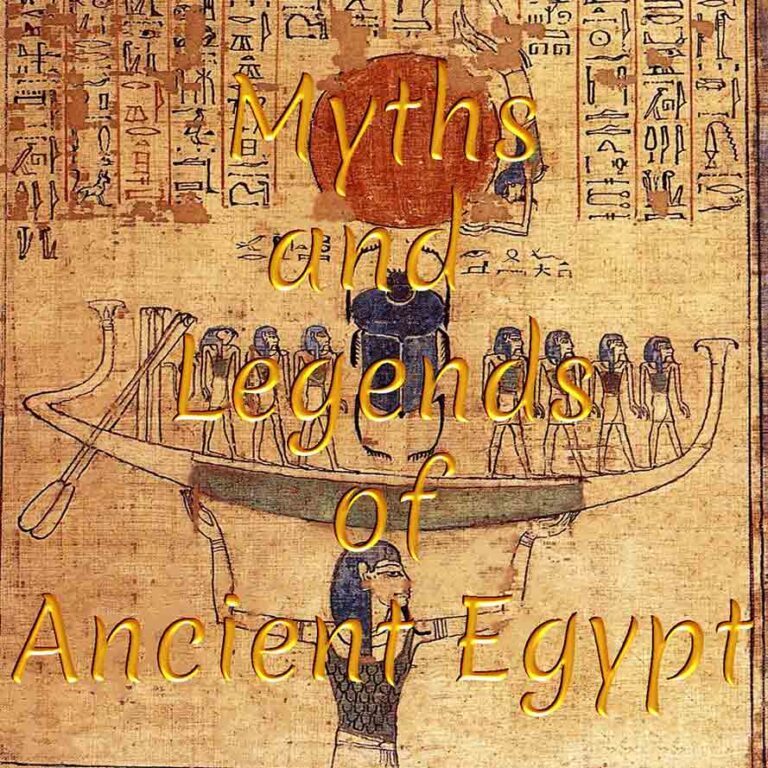
Category: Myths and Legends of Ancient Egypt

Stories of gods, heroes, creation, and cosmic struggle — retold through the lens of ancient sources. This series brings forward the mythic imagination of ancient Egypt, illuminating the narratives that shaped Egyptian religion, kingship, and the rhythm of the cosmos.

  • Myths and Legends of Ancient Egypt: The Book of Knowing the Creations of Ra

    Myths and Legends of Ancient Egypt: The Book of Knowing the Creations of Ra

    The Book of Knowing the Creations of Ra is an ancient Egyptian creation myth that narrates the self-creation of Ra, the sun god, and his role in forming the universe. ​ Ra, also known as Khepra (the scarab beetle of creation), describes his emergence during the sp tpy (First Occasion), the moment of creation. He creates his children, Shu (the lower sky/atmosphere) and Tefnut (sky moisture), through self-insemination and spitting them out. ​ Ra’s bA spirit manifests as Heka (magic), the creative force of the universe, which is invoked in rituals but not inherently present in humans. ​

    Ra continues to create primeval beings from the nnw (primeval waters) and plans further creations using his Eye, representing the physical sun. ​ His children form the Great Ennead (nine deities worshipped at Heliopolis), including Geb (earth), Nut (sky), Osiris, Horus, Seth, Isis, and Nephthys, who further populate the world. ​

    The text transitions into the ritual destruction of App (Apophis), a primeval serpent embodying uncreation and chaos (isft), which threatens the cosmic balance (mAat). ​ Seth defeats App nightly, who spears him to protect Ra’s sun boat during its journey through the dwAt (netherworld). ​ App is imprisoned by Akr, a deity of the horizon, and consumed by the Glorious Eye of Ra, which destroys his bA (spirit), Dt (body), Swyt (shadow), and Heka.

    The myth emphasizes the constant battle between creation and uncreation, the interconnected spirits (bA, kA, Dt), and the importance of maintaining cosmic balance (mAat). ​ The text is part of the Bremner Rhind Papyrus, dated 312-311 BCE, and includes other rituals and hymns. It reflects the rich mythology and spiritual beliefs of ancient Egypt. ​

    Ta'wy Podcast Channel
    Ta’wy Podcast Channel
    Myths and Legends of Ancient Egypt: The Book of Knowing the Creations of Ra
    Loading
    /
  • Myths and Legends of Ancient Egypt: Reckoning of the Mounds of the Primeval Time

    Myths and Legends of Ancient Egypt: Reckoning of the Mounds of the Primeval Time

    Myths and Legends of Ancient Egypt: The Reckoning of the Mounds of Primeval Time is a dramatic retelling of the creation myth associated with the Temple of Horus at Edfu. The story explores the cosmogeny of ancient Egypt, focusing on the primeval mounds that emerged from the waters of chaos at the dawn of time. It highlights the role of Ra, Horus, and other deities in shaping the world and establishing order. The myth is deeply tied to Behdet, an ancient name for Edfu, and reflects Egyptian beliefs about divine rulership and cosmic balance. You can find more details here.

    Ta'wy Podcast Channel
    Ta’wy Podcast Channel
    Myths and Legends of Ancient Egypt: Reckoning of the Mounds of the Primeval Time
    Loading
    /
  • Myths and Legends of Ancient Egypt – Judgment of Horus and Seth

    Myths and Legends of Ancient Egypt – Judgment of Horus and Seth

    The Judgment of Horus and Seth, also known as the Contendings of Horus and Seth, is an ancient Egyptian myth that recounts the story of the gods’ struggle for the throne of Egypt following the death of Osiris. The conflict between Horus, Osiris’ son, and Seth, Osiris’ brother, lasted for decades and involved numerous trials and contests to determine who was the rightful ruler.

    Key Events

    • After Seth murdered Osiris, Horus claimed the throne as his birthright, but Seth argued that he was stronger and more capable of ruling.
    • The gods of the Ennead, led by Ra, acted as judges in the dispute.
    • Horus and Seth engaged in various competitions, including boat races, wrestling matches, and magical duels.
    • At one point, Seth attempted to humiliate Horus by assaulting him, but Horus’ mother, Isis, intervened.
    • The gods debated for years, with some supporting Seth and others favoring Horus.
    • Eventually, Osiris himself intervened from the afterlife, demanding justice for his son.
    • The gods finally ruled in favor of Horus, declaring him the rightful king of Egypt.

    This myth was significant in Egyptian culture because it reinforced the idea of divine kingship, legitimizing the rule of pharaohs as descendants of Horus. It also symbolized the eternal struggle between order (Ma’at) and chaos, with Horus representing stability and Seth embodying disorder.

    Ta'wy Podcast Channel
    Ta’wy Podcast Channel
    Myths and Legends of Ancient Egypt – Judgment of Horus and Seth
    Loading
    /
  • Myths and Legends of Ancient Egypt – The Destruction of Mankind

    Myths and Legends of Ancient Egypt – The Destruction of Mankind

    The Destruction of Mankind is a dramatic myth from ancient Egyptian mythology, found in the Book of the Heavenly Cow. It tells the story of how the sun god Ra sought to punish humanity for their rebellion against him.

    According to the myth, Ra, growing old and weary, overheard humans plotting against him. Enraged, he summoned the other gods for counsel, and they advised him to unleash his Eye, which took the form of the fierce goddess Hathor (who later transformed into Sekhmet) to carry out the destruction. Sekhmet became a bloodthirsty force, slaughtering humans mercilessly.

    However, Ra soon regretted the devastation and sought to stop Sekhmet. To do so, he tricked her by flooding the land with red-dyed beer, making it resemble blood. Sekhmet, thinking it was blood, drank it and became intoxicated, losing her desire for destruction. Thus, humanity was spared, but the myth explains the introduction of suffering and death into the world.

    This tale reflects themes of divine justice, punishment, and mercy, showing the balance between destruction and salvation in Egyptian belief systems. It also highlights the power of Ra and the dual nature of Hathor/Sekhmet as both a nurturing and destructive force.

    Ta'wy Podcast Channel
    Ta’wy Podcast Channel
    Myths and Legends of Ancient Egypt – The Destruction of Mankind
    Loading
    /
  • Myths and Legends of Ancient Egypt: Horus Behdety and the Winged Disk

    Myths and Legends of Ancient Egypt: Horus Behdety and the Winged Disk

    This episode narrates the mythological tale of Horus-Behdety, a form of the Egyptian god Horus, and his battles against the enemies of Ra, the sun god. ​ The story unfolds as Ra and his followers, including Horus-Behdety, embark on a journey to defeat conspirators and enemies who take the forms of crocodiles, hippopotami, and other fiends associated with Seth, the god of chaos. ​
    Key events include:

    Horus-Behdety’s Transformation: Horus-Behdety transforms into the Winged Disk (Apy) and defeats enemies in the heights of heaven, earning titles such as “Great God, Lord of Heaven.” ​
    Battles on Land and Water: Horus-Behdety leads attacks against enemies on land and water, using weapons like spears and chains. He slaughters crocodiles, hippopotami, and other foes, often with the help of metalworkers and divine allies like Nekhbet and Wadjet.
    Sacred Places and Names: The myth establishes the names of various locations, sanctuaries, and objects based on the events of the battles. ​ For example, cities like Teb, Tekhet-met, and Heben are named after Horus-Behdety’s victories. ​
    Seth’s Defeat: Seth, the primary antagonist, is ultimately defeated by Horus-Behdety and Harsiese. ​ Seth’s head is severed, and his fiends are destroyed, symbolizing the triumph of order over chaos. ​
    Symbolism of the Winged Disk: The Winged Disk becomes a protective symbol placed in temples and sanctuaries to ward off evil. ​ It represents Horus-Behdety’s power and victory. ​
    Festivals and Rituals: The myth establishes specific festivals and ceremonies to commemorate Horus-Behdety’s victories, including the “Festival of Sailing.” ​

    The story emphasizes themes of divine protection, the triumph of order over chaos, and the establishment of sacred traditions and symbols in ancient Egyptian religion.

    Ta'wy Podcast Channel
    Ta’wy Podcast Channel
    Myths and Legends of Ancient Egypt: Horus Behdety and the Winged Disk
    Loading
    /