
THE SEVEN HOUSES OF TA’WY
A Complete System in the Tradition of Ordered Structure
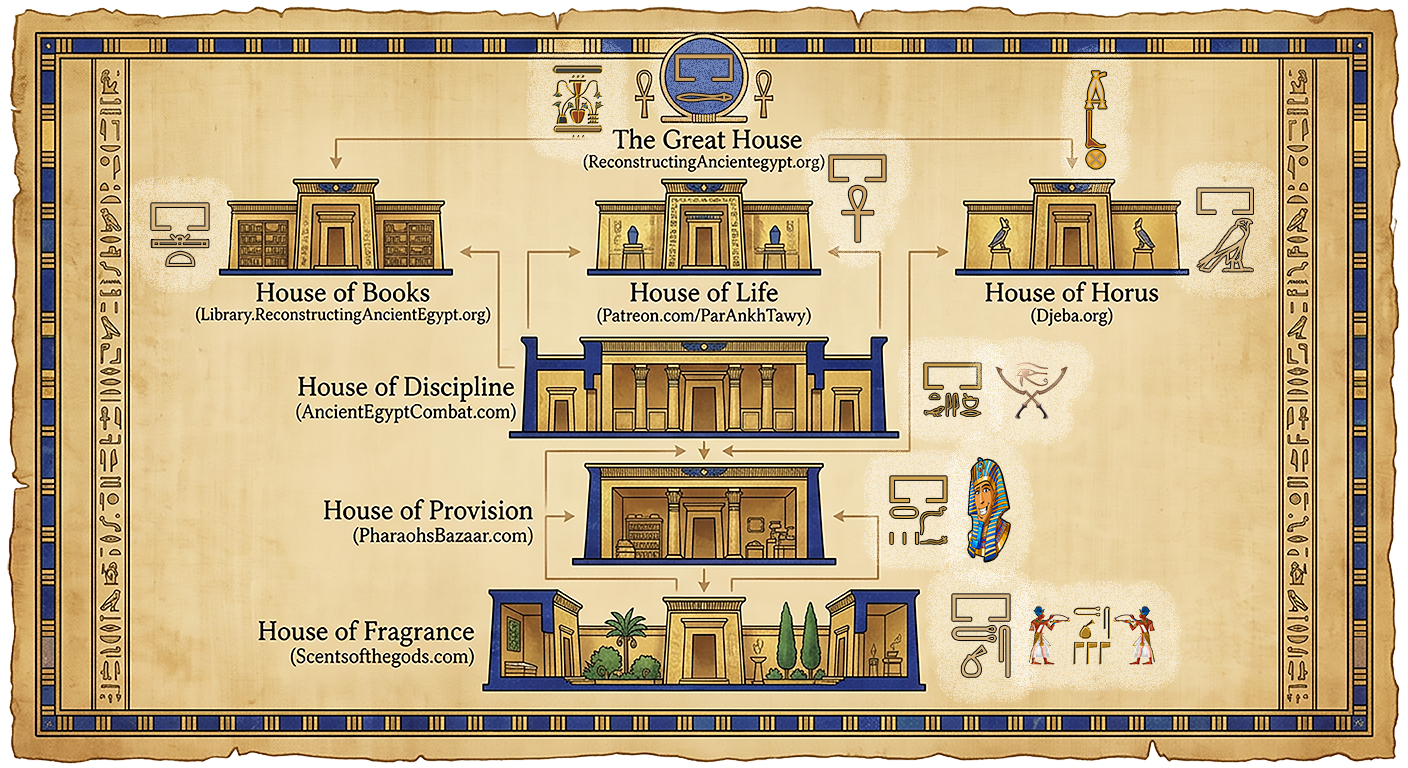

Great House – pr aA
Integration of all Houses

House of Books – pr mDAt
Memory & continuity

House of Life – pr anx
Transmission of knowledge

House of Horus – Pr Hr
Temple form & ritual identity

House of Discipline – pr irdyt
Transformation through discipline

House of Provision – pr Dfaw
Material support & distribution

House of Fragrance – pr sTy
Sensory ritual & embodied experience
- Great House ↓
- House of Books
- House of Life
- House of Horus ↓
- House of Discipline ↓
- House of Provision ↓
- House of Fragrance
Symbolic Meaning of Seven
Seven is the number of cosmic order, purity, magical potency, ritual completeness, totality, and effectiveness in ancient Egyptian tradition.
THE SIGNIFICANCE OF SEVEN IN ANCIENT EGYPT
A Scholarly Foundation for the Seven Houses of Ta’wy
🜂 A Number of Completion and Totality
Across Egyptian religious and ritual texts, seven consistently marks the completion of a cycle, the fulfillment of a process, or the achievement of ritual potency. Egyptologists such as Jan Assmann, Erik Hornung, and Siegfried Morenz identify seven as a number expressing wholeness, cosmic order, and effective magic.
🜁 Seven in Divine and Mythological Groups
Egyptian myth frequently organizes gods and spirits into groups of seven. Examples include:
- The Seven Hathors (goddesses of fate and destiny)
- Seven Spirits / Seven Arrows of Sekhmet (protective and destructive forces) These groupings appear in magical papyri, temple inscriptions, and funerary literature.
🜃 Seven in Ritual and Magical Practice
Egyptian ritual often uses seven-fold repetition to activate or intensify magical power. Scholars such as Robert K. Ritner and J. F. Borghouts document:
- Seven-fold purifications
- Seven sacred oils
- Seven gates or thresholds in the underworld Repetition in sevens was believed to “seal” the ritual and make it effective.
🜄 Seven in Funerary Texts and Cosmic Structure
In texts like the Book of the Dead (Faulkner) and the Amduat, seven appears in:
- Seven gates of the Duat
- Seven protective spells
- Seven stages of transformation These structures reflect the Egyptian view that the cosmos is ordered, layered, and complete.
🔱 Why Seven Matters for Ta’wy
Because seven signifies order, completion, and ritual effectiveness, it provides a historically grounded framework for a modern system modeled on Egyptian principles. The Seven Houses of Ta’wy echo this ancient logic: a complete, unified, and functional structure built on the number that represented totality in Egyptian thought.
Academic Sources Referenced
- Jan Assmann, Death and Salvation in Ancient Egypt
- Erik Hornung, Conceptions of God in Ancient Egypt
- Siegfried Morenz, Egyptian Religion
- Geraldine Pinch, Magic in Ancient Egypt
- Robert K. Ritner, The Mechanics of Ancient Egyptian Magical Practice
- J. F. Borghouts, Ancient Egyptian Magical Texts
- R. O. Faulkner, The Ancient Egyptian Book of the Dead
ONE SYSTEM • MANY HOUSES • ONE PURPOSE
Year 18 of the Reign of Hr‑pnb‑tAwy • wpt rnpt 2026