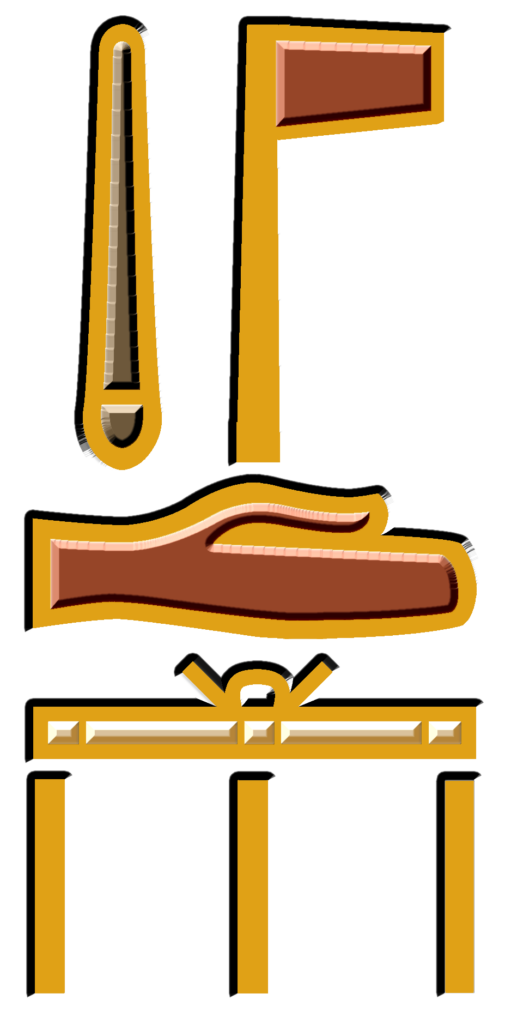
Madu Natjar (mdw nTr), often translated as Divine Speech or Words of the Natjaru (gods), is the ancient language of Egypt. More than a system of communication, it was understood by the ancient Egyptians as a sacred medium through which cosmic order, ritual power, and divine knowledge were expressed. Every inscription—whether on temple walls, funerary objects, monuments, or papyri—was believed to carry an inherent potency that could affect both the seen and unseen worlds.


A Language Woven into Civilization

Madu Natjar permeated all aspects of ancient Egyptian life. It was the language of:

  • Religion and ritual, used in hymns, offerings, and temple liturgies
  • Statecraft and kingship, appearing in royal decrees, annals, and monumental inscriptions
  • Science and philosophy, recording medicine, astronomy, mathematics, and theology
  • Everyday life, through letters, legal documents, and administrative records

Across thousands of years, the language has adapted while maintaining continuity, allowing generations to remain connected to ancestral wisdom and tradition. This continuity formed a cultural bridge between the living, the ancestors, and the gods.


Writing Systems and Forms

Madu Natjar was written using multiple complementary scripts, each suited to different contexts:

  • Hieroglyphs, the formal and sacred pictorial script used primarily on monuments and religious texts
  • Hieratic, a cursive form optimized for administrative, literary, and priestly use
  • Later developments, which eventually led to Demotic and finally to Coptic, the last historical stage of the ancient Egyptian language

Although the scripts changed over time, they all conveyed the same underlying language, preserving its structure and conceptual worldview.


Sound, Symbol, and Meaning

Unlike alphabetic systems that focus solely on sound, Madu Natjar integrates:

  • Phonetic signs that represent consonantal sounds
  • Logographic signs that convey entire words or concepts
  • Determinatives, non‑spoken signs that clarify meaning by categorizing words (for example, marking a word as a deity, place, action, or abstract quality)

This layered system allowed writing to operate simultaneously on intellectual, symbolic, and spiritual levels. The written word was not just read—it was activated.


Survival and Living Legacy

While the everyday spoken forms of Madu Natjar gradually evolved and faded, the language never truly disappeared. Its final phase, Coptic, survived into the Christian era and remains in use today as the liturgical language of the Coptic Orthodox Church. Through Coptic, echoes of ancient Egyptian pronunciation, grammar, and vocabulary have been preserved, providing a vital key for modern reconstruction efforts.


Reconstructing the Spoken Language

Modern efforts to reconstruct how ancient Egyptians spoke Madu Natjar rely on a synthesis of:

  • Indigenous linguistic continuity through Coptic
  • Comparative Afro‑Asiatic linguistics
  • Epigraphic analysis of inscriptions and scribal conventions
  • Cultural and cognitive archaeology, emphasizing how language functioned within Egyptian thought

At Ta’wy, years of dedicated research are directed toward recovering not only grammar and vocabulary, but also pronunciation, rhythm, and cultural context—seeking to approach the language as a lived and embodied experience rather than a purely academic abstraction.


Language as Cultural Memory

For the ancient Egyptians, language was inseparable from identity, cosmology, and ethics. To speak Madu Natjar was to participate in Ma’at—the principle of balance, truth, and cosmic order. Reviving the language today is therefore not simply an act of linguistic study, but a form of cultural restoration: reconnecting sound, meaning, and worldview in a way that honors the civilization on its own terms.


Below are APA 7th edition–formatted references that support the rewritten and expanded material. I’ve divided them into primary (directly tied to the Ta’wy page) and scholarly contextual sources that substantiate claims about the Ancient Egyptian language, its structure, scripts, and reconstruction. All entries follow APA7 conventions.


Cite

McCoy, P. (2026). Madu Natjar (mdw nTr) — The Sacred Language of Ancient Egypt. Ta’wy – Reconstructing Ancient Egyptian Culture
https://reconstructingancientegypt.org/language/


Scholarly and Academic References

Allen, J. P. (2013). The ancient Egyptian language: An historical study. Cambridge University Press.
https://doi.org/10.1017/CBO9781139503658

Allen, J. P. (2020). Middle Egyptian: An introduction to the language and culture of hieroglyphs (3rd ed.). Cambridge University Press.

Erman, A. (1971). Egyptian grammar (H. O. Lange Trans.; 3rd ed.). Oxford University Press. (Original work published 1894)

Faulkner, R. O. (2017). A concise dictionary of Middle Egyptian. Griffith Institute, University of Oxford.

Gardiner, A. H. (1957). Egyptian grammar: Being an introduction to the study of hieroglyphs (3rd ed.). Griffith Institute.

Loprieno, A. (1995). Ancient Egyptian: A linguistic introduction. Cambridge University Press.

Peust, C. (2019). Egyptian phonology: An introduction to the phonological structure of Egyptian. Peust & Gutschmidt Verlag.

Schenkel, W. (1990). Einführung in die altägyptische Sprachwissenschaft. Wissenschaftliche Buchgesellschaft.


Coptic and Linguistic Continuity

Layton, B. (2011). A coptic grammar: With chrestomathy and glossary (3rd ed.). Harrassowitz Verlag.

Reintges, C. H. (2004). Coptic Egyptian (Sahidic dialect): A learner’s grammar. Peeters.


Writing Systems, Semiotics, and Cultural Context

Baines, J. (2007). Visual and written culture in ancient Egypt. Oxford University Press.

Hornung, E. (1999). The ancient Egyptian books of the afterlife. Cornell University Press.

Ritner, R. K. (1993). The mechanics of ancient Egyptian magical practice. Oriental Institute of the University of Chicago.


Notes on Use

  • The Ta’wy page is cited as the authoritative statement of intent and framing for the reconstructed language project.
  • Allen, Loprieno, Gardiner, and Faulkner support grammatical, lexical, and historical claims.
  • Layton and Reintges support claims that Coptic is the final stage and a reconstruction tool.
  • Baines, Hornung, and Ritner substantiate language as a ritualized, performative, and cosmological system rather than a neutral tool.