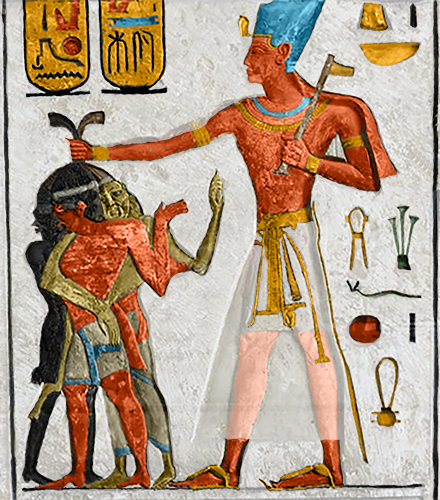
The story revolves around a peasant named xw.n-inpw from the Wadi Natrun region who sets out to Egypt to fetch provisions for his family. On his journey, he encounters nmti-nxt, a servant of the Chief Magistrate, rn-si, son of mrw, who deceitfully blocks his path and seizes his donkeys after accusing them of eating his barley. Despite xw.n-inpw‘s protests and offers to compensate for the barley, nmti-nxt beats him and takes his goods. Xw.n-inpw pleads his case to the Chief Magistrate rn-si, son of mrw, repeatedly over nine petitions, eloquently appealing for justice and condemning corruption. Under orders from Pharaoh nb-kAw-ra, the Chief Magistrate delays responding to the peasant’s pleas to document his eloquent speeches. Meanwhile, provisions are secretly provided to xw.n-inpw and his family. Eventually, the Chief Magistrate presents the peasants’ petitions to Pharaoh, who is impressed by the peasants’ eloquence. The Pharaoh orders justice to be served. nmti-nxt is summoned, and his possessions, including barley, livestock, and goods, are confiscated and given to xw.n-inpw as compensation. The story highlights themes of justice, eloquence, and the struggle against corruption.
Ta’wy Podcast Channel
Ancient Egyptian Literature – The Tale of the Eloquent Peasant
In this episode, we look at the hrw Hryw rnpt, the “Days Above the Year” in the ancient Egyptian calendar. These five added days — created through the wisdom of Thoth — made room for the births of the children of Nut and Geb. They sit outside the normal 360‑day year and mark one of the most important mythological moments in Egyptian timekeeping.
Book Review: Ancient Egyptian Literature vol. II: The New Kingdom. Research on the Web: AERA – Ancient Egypt Research Associates, Inc. Electronic Document: An Ancient Egyptian Hunting Ritual by Eberhard Otto. The Par Madja’t of Kamat is located here.
Ta’wy Podcast Channel
Par Madja’at Ancient Egyptian House of Books – Episode 2
Utilizing Egyptian sourdough yeast is a necessary component in creating ancient Egyptian bread and beer. This video shows you how to activate dehydrated yeast from Egypt, and links to purchase ingredients.
This episode reviews the book Fighting Pharaohs: Weapons and Warfare in Ancient Egypt by Robert B. Partridge, which explores the military history of ancient Egypt, detailing the weapons, strategies, and battles that shaped the kingdom’s power. The book examines the evolution of Egyptian warfare, from early conflicts to the sophisticated military campaigns of the New Kingdom. It covers the use of chariots, bows, spears, and swords, as well as the role of pharaohs as military leaders. The text also discusses fortifications, naval warfare, and the influence of foreign technology on Egyptian military advancements. You can find more details here.,
The journal article “Notes on the Opening of the Mouth” by T. J. C. Baly examines the ancient Egyptian Opening of the Mouth ritual, a funerary ceremony intended to restore the senses and vitality of the deceased. The text critically analyzes previous interpretations of the ritual, discussing its symbolic connection to rebirth, the Horus Eye, and the transition to the afterlife. Baly explores the role of the Sem priest, the use of sacred implements, and the ritual’s connection to funerary rites involving the Tekenu figure. His work provides a scholarly foundation for further studies on Egyptian religious practices. You can find more details here, as well as research on the Web, in the Giza Digital Library: The Giza Mastabas Series.
Ta’wy Podcast Channel
Par Madja’at Ancient Egyptian House of Books Episode 1
The Palermo Stone named after the city in Italy where it is currently in residence, this artifact is a fragment of a larger stele named by Egyptologists as the Royal Annals of the Old Kingdom of Ancient Egypt. The aforementioned stele contains a list of the rulers of the united Two Lands of ancient Egypt from the first dynasty to the mid fifth dynasty, along with some of the significant events of their reigns. The stele also contains the names of rulers of the pre-unification era, and going back to legendary and mythical rulers. The record even includes the rulers of the mythical time when the deities were in the seen world and ruled the land, going back to the Memphite creator deity PtaH, and successor Rع. This gives a particular clue as to the possible syncretism and geographical origin of the stele.
Palermo stone verso side (Image: Hsu, 2010)
Currently the origins of the Palermo fragment are unknown, along with the others of the seven found fragments of the original stele. Theories about the stele all remain in controversy. Its age, location and even whether they are all part of the same stele are under debate. One theory is that given its record ends in the fifth dynasty it is indeed from the Old Kingdom. Another is it may be a copy of the original Old Kingdom work from the twenty fifth dynasty. However the theological record of the mythical era should be taken into account. The pharaohs of the Old Kingdom were centric to the theology of Heliopolis, where Ra the Sun was the force of creation. The Memphite Theology however puts the mummified human deity of Ptah at the head of creation, and Ra coming forth as his creation. This syncretism of theologies started to occur around the first dynasty, when the rulers established the Nome of Inabw Hadj (Walls of White), the fortress of Menes, as Men Nefer (endures beautifully), the capitol of the naswt bitya (of Sedge and Bee) ruler of the Two Lands. This fact also makes for more argument as then it could have had its beginnings in the first dynasty and the stela added to as time went on. Analyses of the hieroglyphs indicate it is not in the original Old Kingdom or even soon after.
Description and Content
Palermo stone fitted with other fragments of the Royal Annals of Old Kingdom Egypt (Image: Lundström, 2010)
The Palermo fragment is approximately 43.5 cm high, 25 cm wide and 6.5 cm thick. The recto inscription consists of 6 horizontal registers of Old Kingdom hieroglyphics. The first register lists the names of predynastic bityw (rulers) of maHan (Lower Egypt), which is indicated by the seated man hieroglyph wearing the dashrat (Red Crown). The second register inscribes the final year a First Dynasty naswt bitya, whom is generally assumed to be either Narmer or Aha. The rest of the register contains the first nine annual entries for his successor, again not named on the fragment, but assumed to be either Aha or Djer. The recto inscription continues with royal annals onto the naswt bitya of the Fourth Dynasty.
The registers continue on the verso, inscribing events during the reigns of rulers down to Neferirkare Kakai, the third ruler of the Fifth Dynasty. It is not known whether the Royal Annals originally continued beyond this point in time. If the ruler is named, the name of his mother is also included. Content includes measurements of the height of the annual inundation of the Nile, details of Sed and other festivals, grain tax collected, monuments, architecture, and warfare.
Click to Return to the Royal Annals of Ancient Egypt
References
Hsu, S.-W. (2010). The Palermo Stone: the Earliest Royal Inscription from Ancient Egypt. Altoriental. Forsch., 37(1), 68–89. http://www.ancientportsantiques.com/wp-content/uploads/Documents/PLACES/Egypt-Libya/PalermoStone-Hsu2010.pdf
Lundström, P. (2010). The Royal Annals of Egypt. File:The Royal Annals of Egypt.png. Wikipedia. https://commons.wikimedia.org/wiki/File:The_Royal_Annals_of_Egypt.png.
Lundström, P. (2017, October 3). Other king lists of Ancient Egypt. Pharaoh.se. https://pharaoh.se/other-king-lists.
The Judgment of Horus and Seth, also known as the Contendings of Horus and Seth, is an ancient Egyptian myth that recounts the story of the gods’ struggle for the throne of Egypt following the death of Osiris. The conflict between Horus, Osiris’ son, and Seth, Osiris’ brother, lasted for decades and involved numerous trials and contests to determine who was the rightful ruler.
Key Events
After Seth murdered Osiris, Horus claimed the throne as his birthright, but Seth argued that he was stronger and more capable of ruling.
The gods of the Ennead, led by Ra, acted as judges in the dispute.
Horus and Seth engaged in various competitions, including boat races, wrestling matches, and magical duels.
At one point, Seth attempted to humiliate Horus by assaulting him, but Horus’ mother, Isis, intervened.
The gods debated for years, with some supporting Seth and others favoring Horus.
Eventually, Osiris himself intervened from the afterlife, demanding justice for his son.
The gods finally ruled in favor of Horus, declaring him the rightful king of Egypt.
This myth was significant in Egyptian culture because it reinforced the idea of divine kingship, legitimizing the rule of pharaohs as descendants of Horus. It also symbolized the eternal struggle between order (Ma’at) and chaos, with Horus representing stability and Seth embodying disorder.
Ta’wy Podcast Channel
Myths and Legends of Ancient Egypt – Judgment of Horus and Seth
The Book of Thoth refers to various ancient Egyptian texts attributed to Thoth, the god of writing, wisdom, and magic. It is often described as containing all knowledge of laws, magic, nature, and the afterlife.
Origins and Mythology
The Book of Thoth is a figure in Egyptian mythology, particularly in a story about Prince Neferkaptah, who stole the book from its hidden location at the bottom of the Nile near Coptos. The book was locked inside a series of boxes guarded by serpents. After retrieving it, Neferkaptah suffered divine punishment—his wife and son were killed, and he eventually took his own life.
Contents and Significance
The book was said to contain two powerful spells:
One allowed the reader to understand the speech of animals.
The other granted the ability to perceive the gods themselves.
Egyptian priests attributed many writings to Thoth, believing he was the source of all knowledge.
Some texts associated with the Book of Thoth discuss scribal work, sacred animals, and the Duat (the realm of the dead).
The Book of Thoth remains a fascinating part of Egyptian mythology, symbolizing hidden wisdom and the dangers of seeking forbidden knowledge.